Abstract
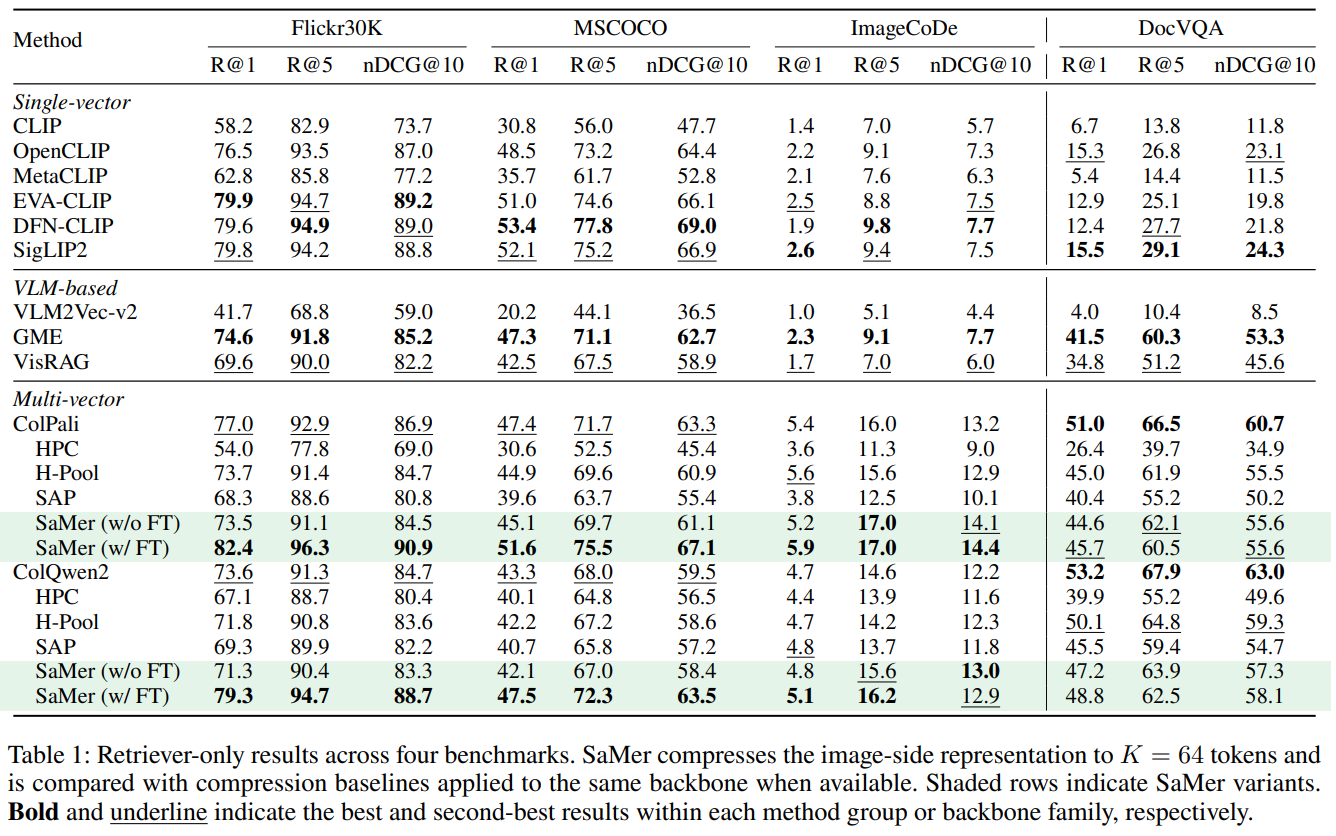
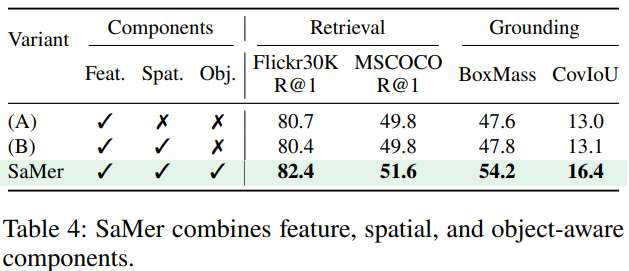
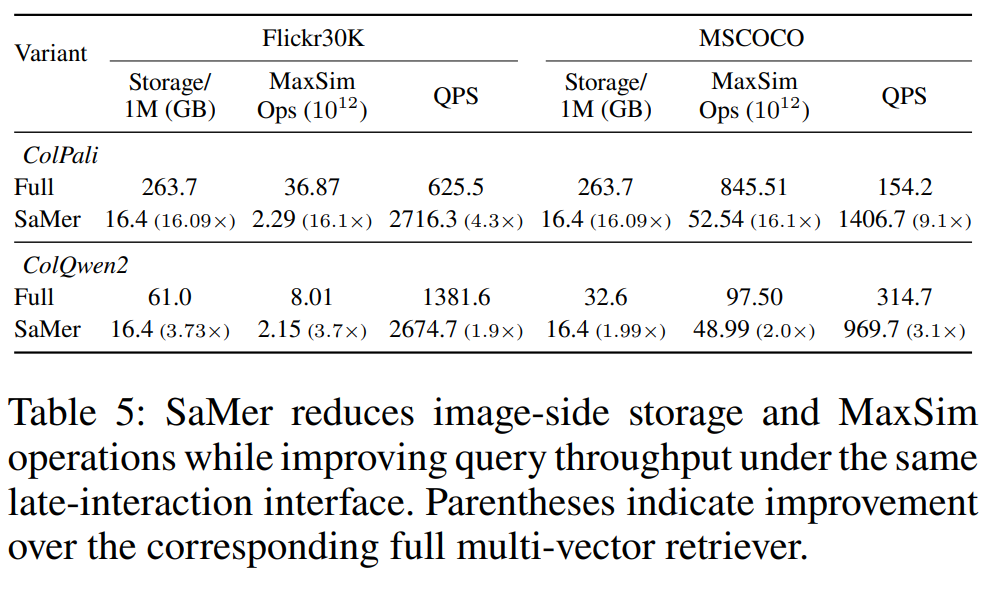
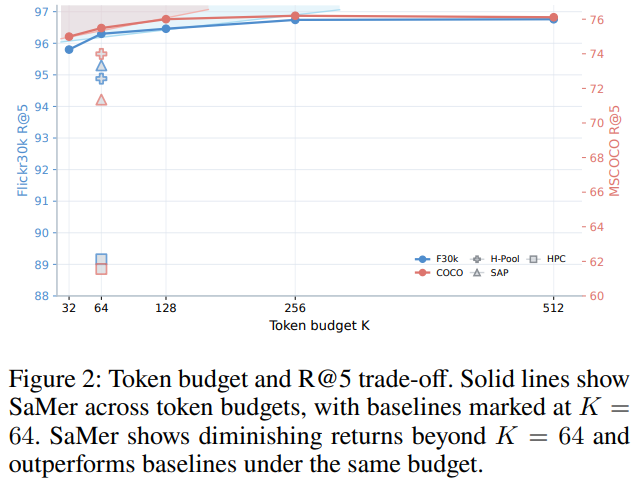
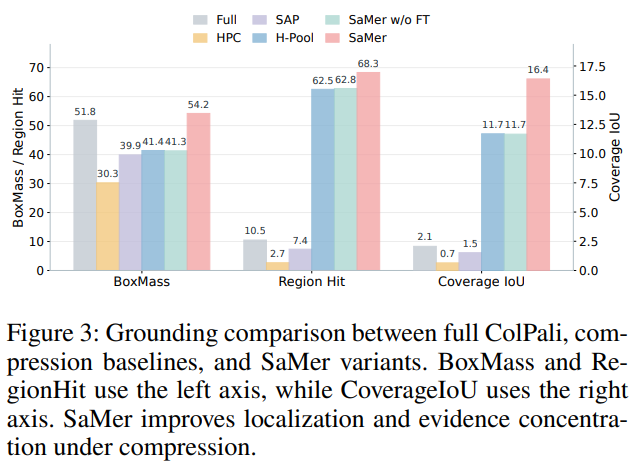
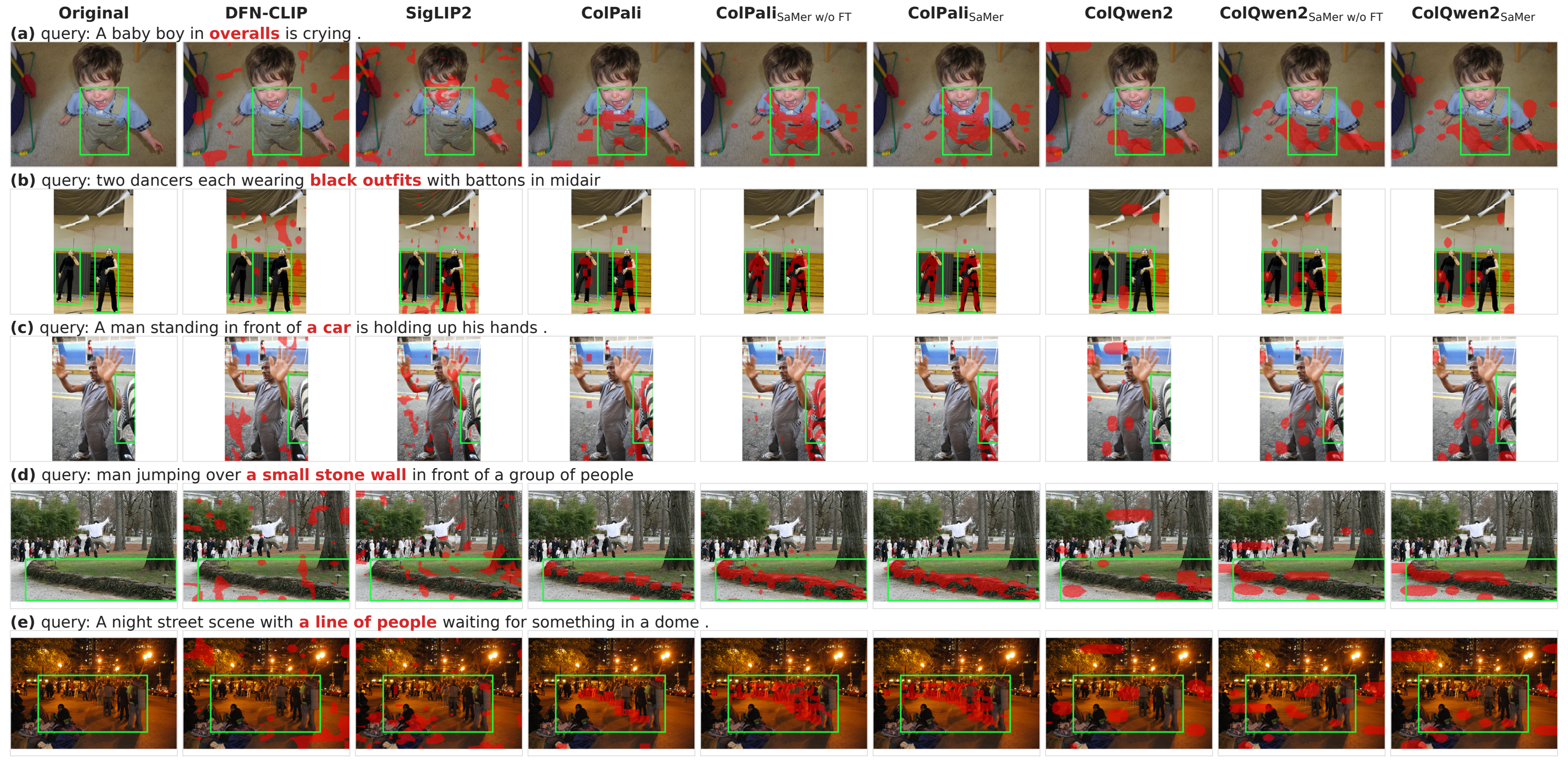
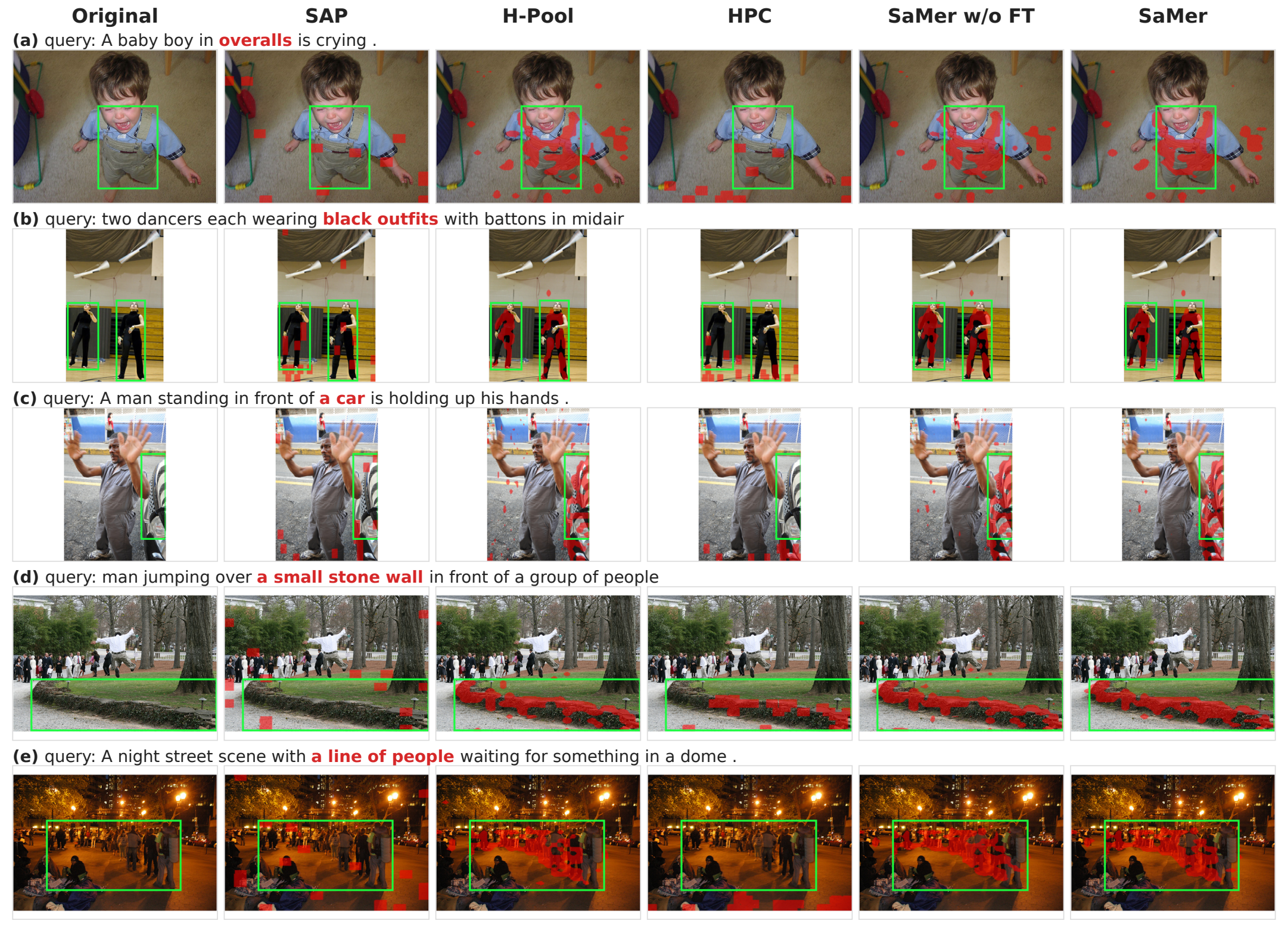
Multi-vector vision-language retrieval preserves fine-grained visual evidence through maximum-similarity late interaction, but dense image-side tokens make storage and scoring expensive. Existing token compression methods reduce this cost, yet they can remove or collapse object- and region-level evidence that future query tokens may need to select. We propose SaMer (Semantic-aware Merging), an object-aware token merging framework that compresses image-side post-projector tokens into \(K\) representative centroids while preserving the original late-interaction interface. SaMer uses object annotations only during training as a merge prior to discourage cross-instance mixing, requires no ground-truth bounding boxes or detectors at inference time, and adapts only the shared projection layer with frozen vision and language backbones. With \(K=64\), SaMer removes more than 93% of image-side tokens and reduces ColPali storage by \(16.09\times\), while improving R@1 on Flickr30K and MSCOCO. These gains arise because object-aware merging preserves query-selectable object evidence that pruning or feature-only pooling can remove or collapse. SaMer also outperforms compression baselines and shows stronger phrase-level grounding, suggesting that efficient multi-vector retrieval depends not only on reducing token count, but on preserving the evidence future query tokens need to select.
Method
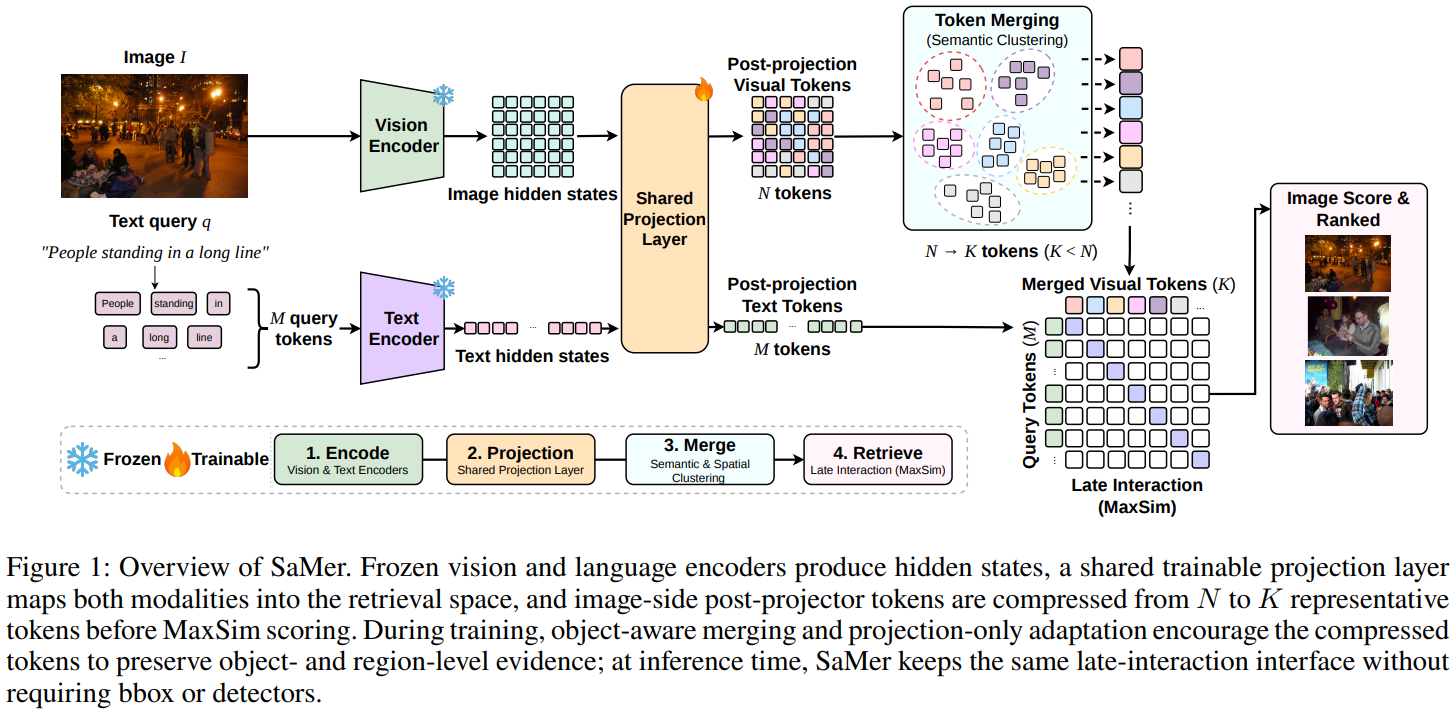
SaMer compresses post-projector visual tokens with an object-aware feature-spatial merge, then scores with the original MaxSim objective — at inference it is entirely bbox-free.
SaMer (Semantic-aware Merging) keeps the original late-interaction interface intact and replaces only the image side with a small set of compressed representatives, through three coordinated steps:
Feature-Spatial Merging
Compresses the many post-projector visual tokens into a small set of representative centroids by soft assignment over a distance that combines feature similarity and 2D spatial coherence.
Object-Aware Merge Prior
During training only, object annotations add an instance-inconsistency penalty that discourages merging tokens from different object instances — no auxiliary grounding loss, no boxes at inference.
Projection-Only Adaptation
Freezes the vision encoder and language backbone and trains only the shared projection layer with a contrastive retrieval objective, pulling each query toward its positive images and pushing away the other images in the batch so the compressed representatives stay aligned with MaxSim scoring.
Main Results
Analysis
Tables
Auto-advances every few seconds — use the ‹ › arrows to browse one table at a time.
Figures
Auto-advances every few seconds — use the ‹ › arrows to browse one figure at a time.
BibTeX
@misc{park2026visualtokensmatterequally,
      title={Do All Visual Tokens Matter Equally? Object-Evidence Preserving Token Merging for Vision-Language Retrieval},
      author={Suhyeong Park and Junha Jung and Jungwoo Park and Jaewoo Kang},
      year={2026},
      eprint={2607.04605},
      archivePrefix={arXiv},
      primaryClass={cs.IR},
      url={https://arxiv.org/abs/2607.04605},
}